

Workers’ compensation data is more complex before an underwriter ever opens the file.
Across the industry, we’ve heard workers’ compensation underwriting teams describe a familiar challenge. The information they need is available, but it rarely arrives ready to use.
Insurance Quantified’s claims analysis shows how wide that gap can become. NCCI defines 78 cause-of-injury classification codes that roll up to 10 general categories. But when Insurance Quantified analyzed raw captured values from actual loss run documents across its workers’ compensation dataset, those same fields produced more than 50,000 unique variations.
For underwriting leaders, that gap explains why workers’ compensation data can be so difficult to classify consistently. We’ve seen this create a familiar pattern for WC teams: before loss history can support pricing, risk selection, or portfolio analysis, someone has to read the source document, interpret the raw information, structure the data, and normalize it into something underwriters can act on with confidence.
Classification complexity becomes more than an intake issue. It shapes how carriers interpret loss history, evaluate severity patterns, and price risk. When raw data arrives with this much variation, the data foundation behind the underwriting decision matters just as much as the decision itself.
Insurance Quantified’s analysis of 2.45 million closed workers’ compensation claims shows that this complexity is real, documented at scale, and already present in the submissions carriers receive every day.
Why workers’ compensation data is harder to classify than most carriers account for
In conversations with workers’ compensation teams, the challenge rarely comes down to whether classification matters. It comes down to how many layers of variation sit between the source document and a usable underwriting data point.
Workers’ compensation has a defined classification structure, but that structure still has to be applied to data that arrives through different documents, systems, states, and reporting requirements. NCCI provides standard codes, while carriers still have to account for state-specific requirements, independent bureau states, multi-state exposures, and the variability of how business operations and injuries are described in raw loss run fields.
That is where classification becomes more than a coding exercise. It becomes a data quality challenge.
NCCI’s classification system includes nearly 800 unique class codes nationally, while state rating requirements add another layer of variation to how those codes are applied and reported. For a single-state account, that may already create enough variation to require careful review. For a multi-state account, payroll, exposures, operations, and loss history may need to be interpreted through multiple jurisdictional requirements before the data can support pricing and risk selection with confidence.
Where classification complexity comes from:
- National classification standards: NCCI provides a framework for classification, but that framework still has to be applied to messy source data.
- State-specific requirements: Rating rules, bureau requirements, and reporting expectations can vary by state.
- Independent bureau states: Some states operate outside the NCCI system, adding another layer of jurisdictional variation.
- Multi-state exposures: A single account can include payroll, operations, and exposures across multiple states.
- Raw loss run variability: Business operations, injuries, and claim details are often described inconsistently across documents, fields, and source systems.
For underwriting teams, the practical issue is that these layers arrive together in the submission. A loss run may contain inconsistent injury descriptions. Payroll may need to be reconciled by state. Operations may be described one way in a schedule and another way in supporting documents. Each variation creates another point where the data has to be reviewed before it can be trusted.
That is why precision in workers’ compensation classification starts with the source document. The goal is to read what is actually captured in the loss run, extract the relevant classification detail, and structure it consistently before it moves downstream. When classification depends too heavily on inference, variation has more room to follow the account into pricing, risk selection, and portfolio analysis.
What this means by carrier type:
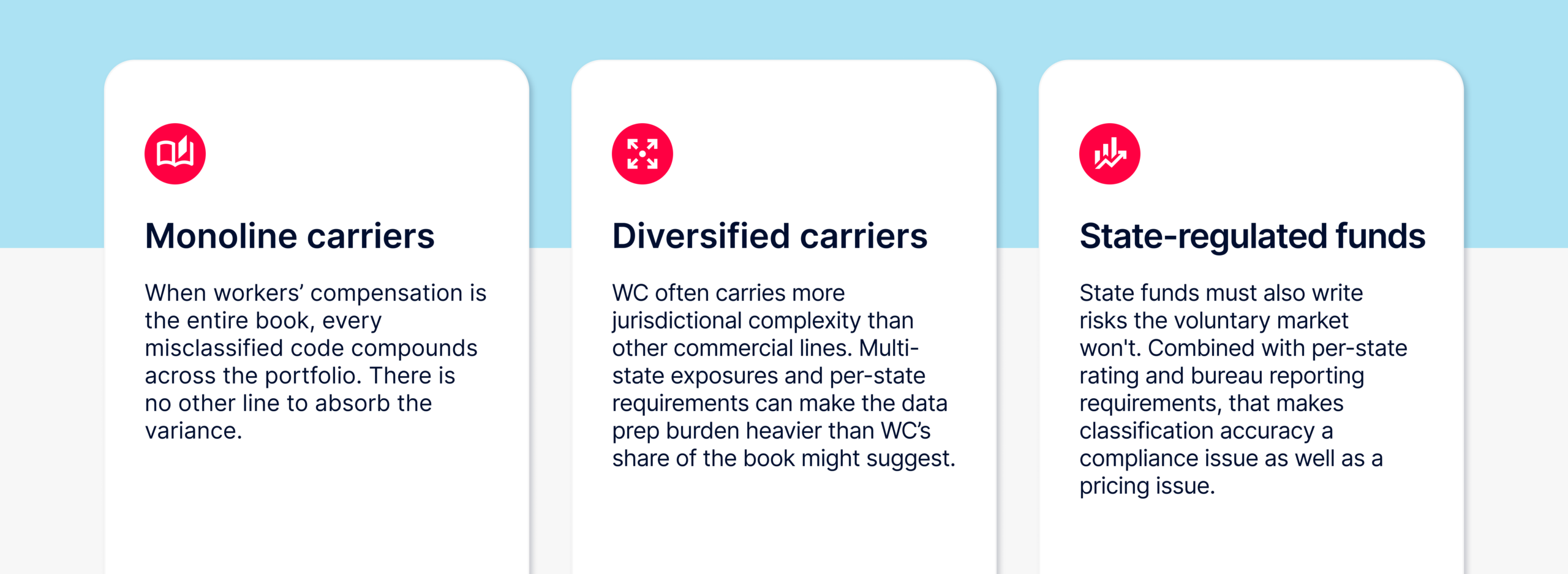
What imprecision actually costs
When workers’ compensation classification data is imprecise, the cost shows up in more than one place. It can affect premium accuracy, underwriting capacity, and the quality of portfolio-level decisions. For underwriting leaders, the concern is practical. If the data foundation is inconsistent, every decision built on that foundation carries more uncertainty.
Pricing confidence
Class codes help determine workers’ compensation premium. When they are incorrect, the premium can be incorrect too. In many cases, that gap becomes visible later through audit rather than at the point of underwriting.
Premium leakage often traces back to the same data issues workers’ compensation teams are already managing upstream: misclassification, underreported payroll, and noncompliance with state rating bureau requirements. Pro Global’s analysis of audits for major U.S. carriers found that effective audits can recover up to 18% in additional premium. That figure represents the difference between what was charged and what the actual risk warranted.
The scale of the issue is significant. The Coalition Against Insurance Fraud estimates that workers’ compensation premium fraud costs insurers $25 billion annually, with misclassification playing a major role.
Where premium leakage can start:
- Misclassified class codes
- Underreported payroll
- Missed or inconsistent rating bureau requirements
- Errors that surface later through audit
Underwriter bandwidth
We’ve heard workers’ compensation teams describe the same operational pattern from different starting points. The submission contains the information underwriters need, but the data has to be reviewed, cleaned, structured, and reconciled before it can support a decision.
That work often lands with underwriting or operations teams. In workers’ compensation specifically, 60% to 80% of underwriting time can be consumed by submission processing and decision preparation, leaving less time for actual risk assessment.
Where underwriter time gets pulled:
- Preparing loss runs
- Reconciling payroll
- Checking class codes
- Resolving inconsistencies across documents
Downstream risk quality
Misclassified accounts can distort the portfolio-level signals underwriting leaders rely on to manage the book. If incoming data is inconsistent, the patterns produced by that data can become inconsistent too. That affects how leaders evaluate claim severity, identify concentration, refine appetite, and compare performance across segments.
This is especially important in workers’ compensation because severity patterns vary by injury type, state, classification, and exposure. When those inputs are imprecise, the insights built from them carry the same weakness downstream.
Where imprecision moves downstream:
- Claim severity analysis
- Appetite refinement
- Portfolio segmentation
- Performance comparisons across states, classes, or injury types
What this means by carrier type:
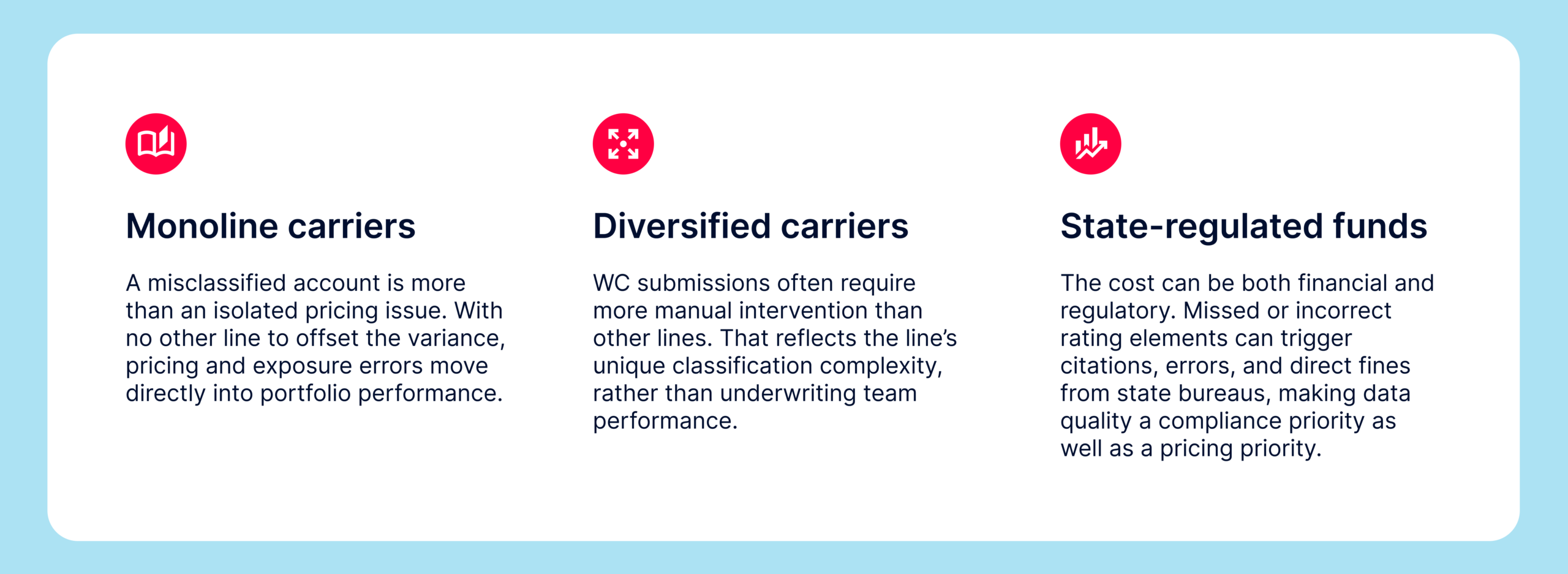
What 2.45 million closed claims reveal about workers’ comp data quality
This complexity is documented at scale. Insurance Quantified analyzed 2.45 million closed workers’ compensation claims to understand what classification variation looks like in practice, and how the gap between raw loss run data and usable claims intelligence affects the accuracy of industry benchmarks.
What our analysis revealed about severity patterns, classification variance, and data quality is the subject of the full guide. Together, these findings point back to the same issue: imprecise classification weakens the data foundation underwriting teams depend on. When classification data is captured, structured, and validated earlier in the workflow, carriers are better positioned to price with confidence, preserve underwriting bandwidth, and make portfolio decisions from a clearer view of risk.
For a deeper look at the data behind these findings, download the guide to see what 2.45 million closed workers’ comp claims reveal about classification complexity, severity patterns, and risk selection.
Sources: Insurance Quantified proprietary dataset (2.45M closed workers’ compensation claims). National Council on Compensation Insurance (NCCI), classification code standards. Pro Global, cited via Insurance Business Magazine, October 2025. Coalition Against Insurance Fraud, cited via Insurance Journal, July 2024.